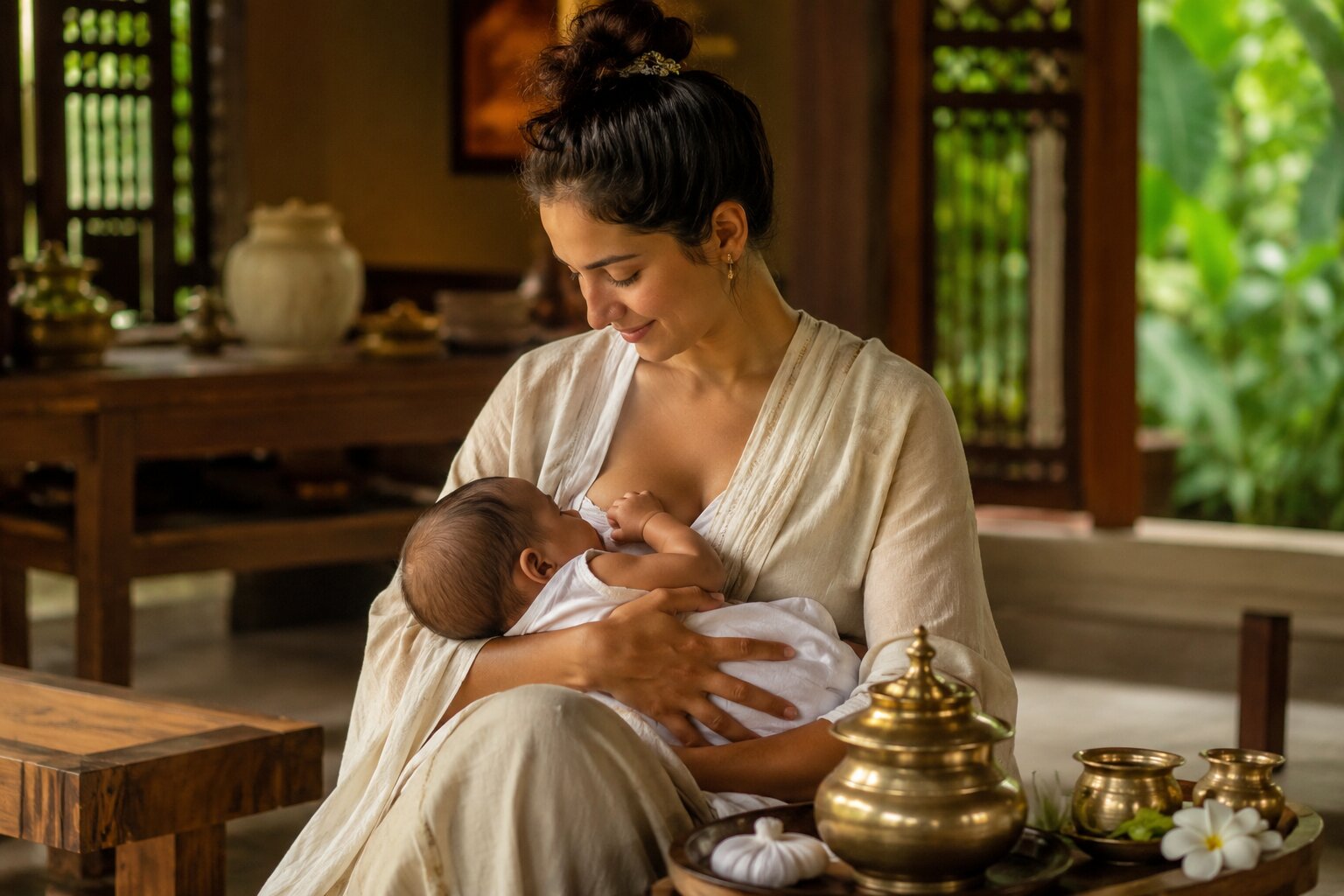
A woman does not simply “recover” after childbirth. She is reborn into another body, another rhythm, another tenderness, another exhaustion. Just a few or more months after birth, many mothers silently whisper to themselves: “Why am I still so tired? Why does my body feel like it no longer belongs to me? Why does everyone expect me to continue as before?” From the perspective of traditional Ayurvedic wisdom – especially as preserved in Sri Lanka – this state is neither unusual nor a sign of weakness. It is a sacred physiological and emotional passage that deserves protection, nourishment, slowness, and reverence. The postpartum and breastfeeding mother, in Ayurvedic understanding, is not “finished” with birth after a few weeks. She is still healing, still rebuilding, still pouring life from herself into another human being.
The modern world often speaks to mothers with a language of productivity. “You should be back at work. You should regain your figure. You should manage the house, smile, breastfeed, sleep little, remain emotionally available, and somehow still look rested.” But the body of a breastfeeding woman speaks another language – one that asks for softness, warmth, minerals, emotional safety, grounding, and care. When a mother says, “I feel like I’m living in survival mode,” Ayurveda listens carefully. It hears the complaint as depletion, or weakness as profound healing.
Birth leaves a woman in a state of heightened vulnerability. In Ayurvedic medicine, this period is strongly associated with an increase in Vata dosha – the principle of movement, dryness, instability, nervous exhaustion, coldness, irregularity, and depletion. Childbirth itself is seen as one of the greatest Vata-provoking events in a woman’s life. Blood loss, hormonal shifts, interrupted sleep, emotional responsibility, breastfeeding demands, and carrying the invisible mental load of motherhood continue to disturb this balance long after the newborn stage.
In Sri Lankan Ayurveda, which developed over centuries in dialogue with South Asian classical medicine and local medicinal traditions, the postpartum mother is often approached as a being in transition who must be restored slowly. Traditional village wisdom never assumed that a woman should immediately return to normality. Instead, a new mother was historically surrounded by female relatives, herbal care, warming foods, oil applications, baths, and periods of protected rest. While modern life has fragmented these structures, many Ayurvedic retreats and physicians in Sri Lanka still preserve this philosophy – especially for mothers seeking recovery during breastfeeding.
A mother in postpartum may wonder: “Why am I still not feeling strong?” Ayurveda would gently respond: because your body is still giving. Breastfeeding itself is not neutral; it is energetically expensive. Milk, according to Ayurvedic understanding, emerges from deeply nourished bodily tissues. If nourishment is insufficient, the mother becomes depleted before the body allows nourishment to stop reaching the child. This is one reason many breastfeeding women report lowered immunity, weakness, hair loss, dizziness, emotional fragility, dryness, anxiety, or a profound sense of emptiness. The body prioritizes the baby. Ayurveda asks: “Who is nourishing the mother?”
Sri Lanka, especially in its Ayurvedic healing environments, offers something deeply attractive to women who feel abandoned by fast-paced postpartum culture: the possibility of slowing down without guilt. For a breastfeeding mother, an Ayurvedic retreat is not something about luxury or cosmetic wellness. When we speak of re-entering into relationship with the body. It is remembering that recovery is not spoken by the language of indulgence. It is medicine.
Imagine a mother waking not as much to alarms, deadlines, or expectations, but just to mountain air or rainforest sounds. Imagine food prepared specifically for rebuilding tissues weakened by childbirth and lactation – warm, digestible, mineral-rich, immune-supportive meals rather than rushed snacks eaten while standing. Imagine practitioners asking not only “How is the baby?” but also “How is your nervous system? How are your emotions? Are you sleeping? Do you feel held?” For many women, this alone becomes healing.
From an Ayurvedic perspective, postpartum and breastfeeding support rests upon several essential pillars. The first is warming nourishment. Cold, processed, irregular eating patterns are considered particularly harmful during maternal depletion. A weakened mother often experiences compromised digestion – something Ayurveda calls weakened agni, the digestive fire. When digestion weakens, even nutritious food is not fully transformed into strength. Thus, Sri Lankan Ayurvedic care often emphasizes soups, broths, herbal porridges, lightly spiced rice dishes, nourishing stews, warm medicinal drinks, sesame, ghee in moderation, herbal infusions, cumin, fennel, ginger adapted for breastfeeding compatibility, moringa leaves, jackfruit preparations, red rice, mung dhal, and medicinal plant combinations intended to strengthen immunity and vitality.
But Ayurveda does not reduce motherhood recovery to nutrition alone. Touch becomes medicine. One of the most emotionally profound experiences for exhausted mothers in Sri Lankan Ayurvedic centers is often abhyanga, the therapeutic oil massage. For a breastfeeding mother who feels emotionally and physically fragmented, warm herbal oils applied with slow grounding movements can restore a sense of embodiment. Many women after months of caring for everyone else suddenly realize: “No one has touched me gently in months without needing something from me.” Ayurveda understands this grief.
Warm oil treatments are traditionally believed to calm aggravated Vata, improve circulation, support nervous system regulation, reduce muscular tension, help sleep quality, soothe dryness, and psychologically communicate safety to the body. In modern language, one could say such treatments activate states of rest rather than survival. And perhaps that word – survival – is central here. Many mothers are not failing motherhood. They are simply surviving it without support.
The emotional dimension of breastfeeding exhaustion deserves equal tenderness. Ayurveda recognizes that emotional states and physical vitality are inseparable. Loneliness, overstimulation, resentment, sadness, feeling unseen, guilt for wanting rest – these are not secondary experiences. They are part of maternal healing. A mother longing for “a realm that hears women after birth” is not trying to romanticize the past. She is articulating a biological and emotional truth: women heal better when supported.
In many traditional Sri Lankan contexts, there existed an understanding that the postpartum mother should not be left alone psychologically. Elder women transmitted practical wisdom: rest when possible, eat warm food, avoid overexertion, maintain warmth, receive herbal baths, protect emotional equilibrium. While no culture was perfect, the underlying principle remains powerful: motherhood changes a woman profoundly, and society should change around her temporarily in response.
This is why many international mothers seeking Ayurvedic retreats in Sri Lanka are not merely looking for a vacation to feel nice. They are looking for recognition. They are seeking a place where breastfeeding is not treated as an inconvenience, where a baby is welcomed rather than viewed as an obstacle to healing, where a woman’s slowness is not judged, and where care extends beyond beauty into restoration.
For a mother in postpartum, choosing an Ayurvedic retreat requires discernment. Not every wellness center understands postpartum physiology or breastfeeding realities. A genuinely supportive environment should welcome mother and baby together, understand lactation-compatible therapies, avoid overly detoxifying or fasting-oriented regimens inappropriate for breastfeeding, provide nutrient-dense meals, allow flexibility around the baby’s rhythms, and prioritize nervous system restoration rather than intensive purification. Classical Ayurvedic detoxification methods are often modified or delayed during breastfeeding because rebuilding is usually prioritized over aggressive cleansing.
Perhaps the deepest healing available in such spaces is intangible. It is the emotional permission to stop pretending everything is fine. To sleep without guilt. To cry if needed. To say: “I am tired. I need support. I miss myself. I want to feel held too.”
There is something quietly sacred about a mother feeding life from her own body while feeling emptied herself. Ayurveda does not see this as failure. It sees it as evidence of profound giving – giving that requires replenishment. A breastfeeding mother in no way is not asking for too much when she seeks warmth, rest, support, nourishment, and healing. She is asking for exactly what the female body has always needed after birth.
And perhaps this is the deeper call hidden beneath exhaustion: I would not call it simply as a retreat, but a return – a return to cultures of care, to embodied wisdom, to slower rhythms, to the understanding that a woman after childbirth is not meant to heal alone.
Perhaps your body is wiser than you think. Perhaps it is not breaking down. Perhaps it is calling you home to restoration.
Let`s see together what can be done to sustain you.